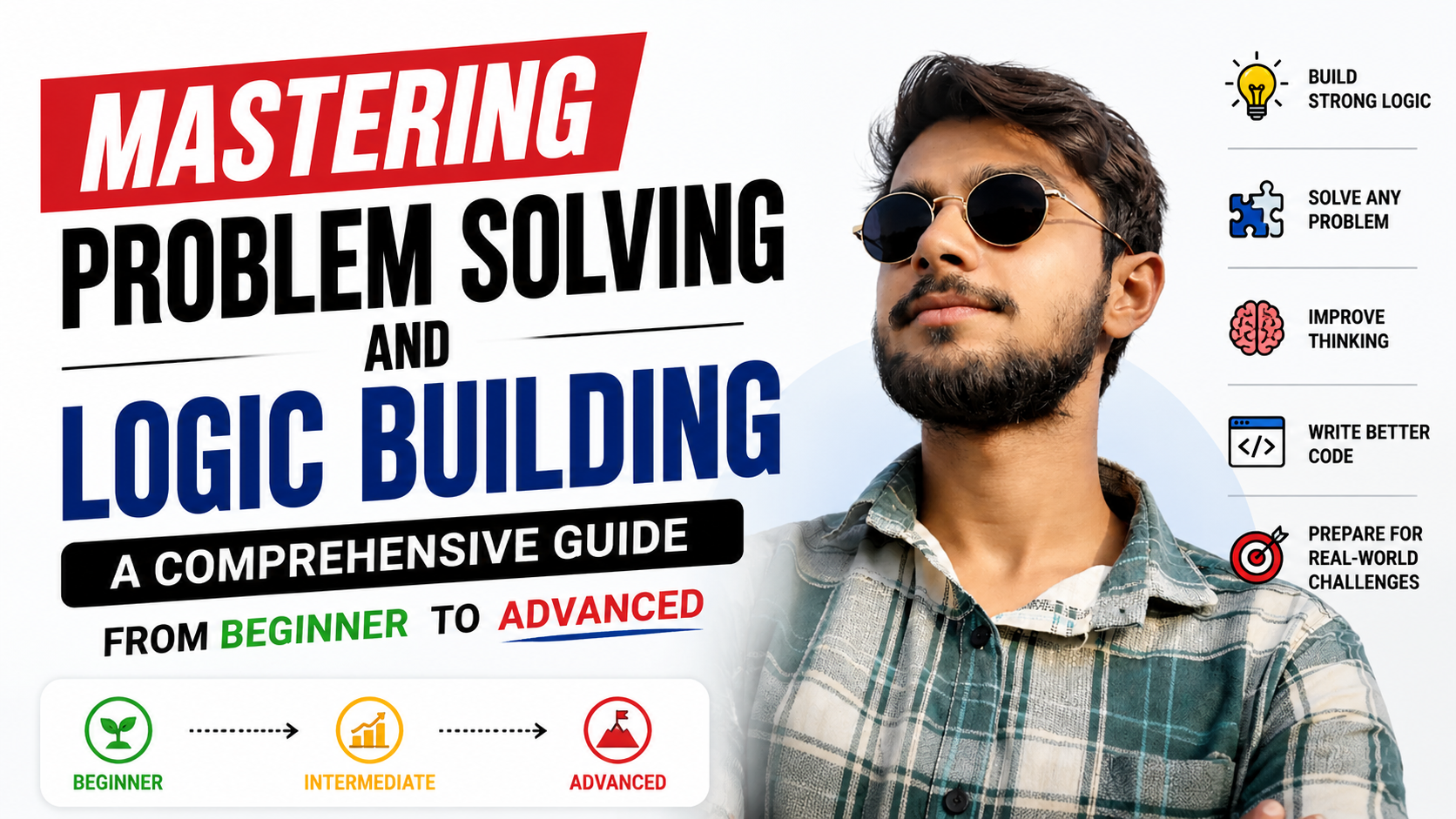
The Art of Thinking: Why Logic Building is the Core of Programming
Many aspiring developers make the mistake of focusing solely on the syntax of a language. They learn how to write a for loop in Python or a map function in JavaScript, but when faced with a blank editor and a complex problem statement, they freeze. This is because there is a fundamental difference between coding and problem solving.
Coding is the act of translating a solution into a language the computer understands. Problem solving, however, is the process of designing that solution. Logic building is the bridge between the two. Whether you are preparing for FAANG interviews or building a scalable SaaS product, your ability to decompose a problem and architect a logical flow is what defines your seniority as an engineer.
Phase 1: The Beginner's Foundation (The Mental Shift)
For a beginner, the biggest hurdle is often the "fear of the blank page." The goal here is not to write code immediately, but to train your brain to think computationally.
1. Decomposition: Breaking the Big into Small
Every complex problem is simply a collection of smaller, manageable problems. If you are asked to build a "Library Management System," don't start with the database. Break it down:
- How do I add a book?
- How do I search for a book?
- How do I track who borrowed which book?
- How do I handle overdue fines?
2. The Power of Pseudocode
Before touching the keyboard, write your logic in plain English. Pseudocode allows you to focus on the logic without worrying about semicolons or indentation.
Example: Finding the largest number in a list
- Initialize a variable
maxwith the first element of the list. - Loop through each element in the list.
- If the current element is greater than
max, updatemaxto be this element. - After the loop ends, return
max.
3. Mastering Basic Control Flow
To build logic, you must master the three pillars of control flow:
- Sequential Logic: Executing statements one after another.
- Conditional Logic: Using
if-elseandswitchstatements to make decisions. - Iterative Logic: Using
for,while, anddo-whileloops to handle repetitive tasks.
Phase 2: Intermediate Logic (Patterns and Data Structures)
Once you can solve basic problems, you will notice that many problems share similar patterns. Instead of memorizing solutions, you should learn to recognize these patterns.
1. Understanding Time and Space Complexity (Big O)
Logic building isn't just about getting the right answer; it's about getting the most efficient answer. Understanding Big O notation helps you evaluate if your solution will crash when the input grows from 10 items to 1 million items.
- O(1): Constant time (Fastest)
- O(log n): Logarithmic time (e.g., Binary Search)
- O(n): Linear time (e.g., Simple loop)
- O(n²): Quadratic time (e.g., Nested loops)
2. Choosing the Right Tool (Data Structures)
Your logic is only as good as the data structure you use. Choosing the wrong structure can make a simple problem incredibly complex.
- Arrays/Lists: Best for ordered data and index-based access.
- Hash Maps/Dictionaries: Essential for O(1) lookups and frequency counting.
- Stacks/Queues: Perfect for LIFO (Last-In-First-Out) and FIFO (First-In-First-Out) scenarios.
- Trees/Graphs: Necessary for hierarchical data or network-based problems.
3. Common Algorithmic Patterns
Start practicing these common patterns to speed up your logic building:
- Two Pointers: Useful for searching pairs in a sorted array.
- Sliding Window: Ideal for finding subarrays or substrings.
- Recursion: Solving a problem by solving smaller versions of the same problem.
# Example of a simple recursive function to calculate factorial
def factorial(n):
    if n == 1: # Base case
        return 1
    else:
        return n * factorial(n - 1) # Recursive call
Phase 3: Advanced Problem Solving (Architectural Thinking)
At the advanced level, problem solving shifts from "How do I solve this puzzle?" to "How do I design a system that is maintainable, scalable, and efficient?"
1. Dynamic Programming (DP)
DP is the pinnacle of logic building for many. It involves breaking a problem into overlapping subproblems and storing the results (memoization) to avoid redundant calculations. If you see a problem asking for the "maximum," "minimum," or "number of ways to do X," it's likely a DP problem.
2. Graph Theory and Complex Traversal
Advanced logic often involves navigating complex relationships. Mastering Breadth-First Search (BFS) and Depth-First Search (DFS) allows you to solve problems like finding the shortest path in a map or detecting cycles in a dependency graph.
3. The "Edge Case" Mindset
An advanced developer spends 20% of their time on the happy path and 80% on the edge cases. To build robust logic, always ask:
- What if the input is empty?
- What if the input contains negative numbers?
- What if the input is extremely large (Integer overflow)?
- What if the network fails mid-process?
The Roadmap to Mastery: A Daily Routine
Logic building is a muscle; it requires consistent exercise. Here is a recommended routine:
- The 30-Minute Rule: Try to solve a problem for 30 minutes on your own. If you are completely stuck, look at a hint, not the full solution.
- Analyze Multiple Solutions: After solving a problem, look at the top-voted solutions on platforms like LeetCode or HackerRank. Compare their approach with yours. Why is theirs faster?
- Dry Running: Use a pen and paper to trace your variables step-by-step. This is the most effective way to find logical flaws.
- Teach It: Explain your logic to a peer or write a blog post about it. If you can't explain it simply, you don't understand it deeply enough.
Conclusion
Building logic is a journey from the concrete to the abstract. It starts with simple loops and ends with complex system designs. Remember that every expert was once a beginner who struggled with a while loop. The key is persistence, a structured approach to decomposition, and a relentless curiosity about how things work under the hood. Keep coding, keep breaking things, and most importantly, keep thinking.